IMPORTANT NOTICE: Please read the following information regarding the future of First Aid at Work training.
The First Aid Quality Partnership (FAQP) has issued an important position statement regarding the management of life-threatening (catastrophic) bleeding in first aid situations. This development reflects increased emphasis by the Health and Safety Executive (HSE) on addressing catastrophic bleeding and the growing demand from stakeholders in the first aid industry.
This statement highlights the evolving landscape of first aid training, particularly the inclusion of advanced techniques for managing severe bleeding. These measures aim to ensure that first aiders are equipped with the necessary skills to save lives in high-risk situations.
Key Points from the Statement
-
Inclusion of IMPROVISED Tourniquets and Wound Packing in FAW Training
All First Aid at Work (FAW) courses should include the use of IMPROVISED tourniquets and IMPROVISED wound packing for managing life-threatening bleeding.
-
Training on Manufactured Solutions Where Risks Are Identified
Employers who identify a risk of catastrophic bleeding should follow HSE guidance to provide training in the use of manufactured tourniquets and manufactured wound packing.
The definitions for ‘improvised’ and ‘manufactured’ tourniquets and wound packing can be found in the table below:
| Tourniquet |
Wound Packing |
|
Purpose: For life-threatening bleeding from an arm or leg that cannot be controlled by direct manual pressure.
|
Purpose: For life-threatening bleeding from a deep wound that cannot be controlled by direct manual pressure.
|
|
Improvised: Applied using materials like a triangular bandage wrapped around a limb and tightened with an improvised twisting device, such as cutlery.
|
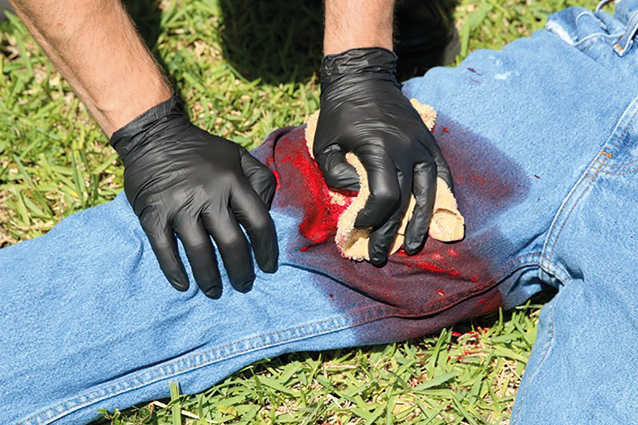
Improvised: Material is packed tightly into the wound to apply pressure. Items like bandages or clothing could be used.
|
|
Manufactured: A commercially manufactured tourniquet is applied around a limb to stop blood flow and control life-threatening bleeding.
|
Manufactured: A haemostatic dressing is used to pack the wound. Haemostatic dressings are impregnated with an agent that rapidly clots blood.
|
Timelines for Implementation
The use of improvised tourniquets and improvised wound packing for life-threatening (catastrophic) bleeding should be included on all First Aid at Work courses.
The formal inclusion of improvised techniques in the FAW syllabus will coincide with the Resuscitation Council's 2025 protocol updates in October 2025. From early 2026, these techniques will be a mandatory requirement for all FAW courses.
Trainer/assessors must complete training in IMPROVISED life-threatening bleeding techniques by January 2026 to comply.
Options for Meeting this Requirement:
-
If you are already trained in life-threatening (catastrophic) bleeding:
If you've already completed training in life-threatening (catastrophic) bleeding through Nuco no further action is required, as we already hold your qualification on file.
Evidence from other providers should be submitted to Nuco for verification. Below is a list of acceptable qualifications; however, it is not exhaustive. If you hold a different qualification covering life-threatening (catastrophic) bleeding, please provide evidence for our review.
- Life-threatening (catastrophic) bleeding certificates from other Awarding Organisations
- Life-threatening (catastrophic) bleeding certificates from St Johns, St Andrews, Red Cross
- Qualsafe Level 3 Award in First Response Emergency Care (RQF)
- Qualsafe Level 4 Certificate in First Response Emergency Care (RQF)
- Qualsafe Level 5 Diploma in First Response Emergency and Urgent Care (RQF)
- FAQ Level 3 Award for First Responders on Scene: Emergency First Responder
- FAQ Level 3 Award for First Responders on Scene: Ambulance Service Community Responder
- FAQ Level 3 Award for First Responders on Scene: Ambulance Service Co-Responder
- FAQ Level 3 Certificate for Ambulance Service First Responders
- FAQ Level 3 Award in Immediate Emergency Care: Fire and Rescue
- FAQ Level 3 Certificate for First Responders on Scene
- QNUK Level 3 Award for First Responders (RQF)
- QNUK Level 3 Award for the First Person on Scene (International) (RQF)
- QNUK Level 3 Award in Rescue Trauma and Casualty Care (RTACC) (RQF)
- QNUK Level 3 Award in First Aid Trauma and Casualty Care (FTACC) (RQF)
- Pearson BTEC Level 3 Certificate for First Person on Scene
- Pearson BTEC Level 4 Certificate for First Person on Scene
- Pearson BTEC Level 4 Extended Certificate for First Person on Scene
- Highfield Level 3 Award in First Aid Response (RQF)
- Highfield Level 3 Award in Emergency Care for First Responders (RQF)
- TQUK Level 3 Award for Initial Person on the Scene of an Incident (RQF)
You can email your evidence to catbleed@nucotraining.com. Please allow sufficient time for us to review your submission. There is no fee for this.
-
If you are scheduled to attend a Nuco ‘first aid’ instructor course or instructor update course during 2025
If you are scheduled to attend a Nuco ‘first aid’ instructor update course during 2025, training in improvised bleeding control will be included as part of your course. New instructors attending a Nuco 'first aid' instructor course in 2025 will also receive this training to ensure they meet the requirements for delivering First Aid at Work courses.
-
Nuco E-learning
From early 2025, an e-learning course will cover improvised techniques. This satisfies minimum requirements to continue delivering FAW courses in 2026 but will not cover full life-threatening (catastrophic) bleeding, which requires teaching manufactured tourniquets and haemostatic dressings.
-
Attend a Nuco Life-Threatening (Catastrophic) Bleeding Workshops
Our online workshops provide comprehensive training, including manufactured techniques, and are conducted live via webinar. This will meet the minimum requirements for 2026 but also allow you to register to teach all aspects of life-threatening (catastrophic) bleeding.
-
Source training from Other Providers
You may source training elsewhere and submit evidence to Nuco to update your profile.
You can email your evidence to catbleed@nucotraining.com. Please allow sufficient time for us to review your submission. There is no fee for this.
How Can I Check I Meet This Requirement?
You can check your qualifications portfolio on NucoPlus to confirm if 'IMPROVISED Life-Threatening (Catastrophic) Bleeding' is displayed under your current achievements. If it is not listed and you intend to teach First Aid at Work in 2026, you will need to follow one of the steps outlined above to meet the requirements.
Employer Requirements for High-Risk Environments
Employers identifying catastrophic bleeding risks should ensure workers receive HSE-recommended training in manufactured tourniquets and haemostatic dressings. These advanced techniques can be delivered as an add-on to FAW or Emergency First Aid at Work (EFAW) courses, requiring additional training time.
This is a significant update to first aid practices, ensuring first aiders are better equipped to handle life-threatening bleeding. If you have any questions or need further assistance, please contact us.